Choose timezone
Your profile timezone:
Charged-particle emission following negative muon nuclear capture (µNC) provides a unique experimental window on the de-excitation of highly excited nuclei. While proton emission has been widely studied, much less is known about the energy spectra of composite charged particles such as deuterons, tritons, and alpha particles, particularly at low energies where detection is experimentally challenging. In this work, energy spectra of protons, deuterons, tritons, and alpha particles emitted after µNC on natural silicon were measured at the RIKEN-RAL Muon Facility.
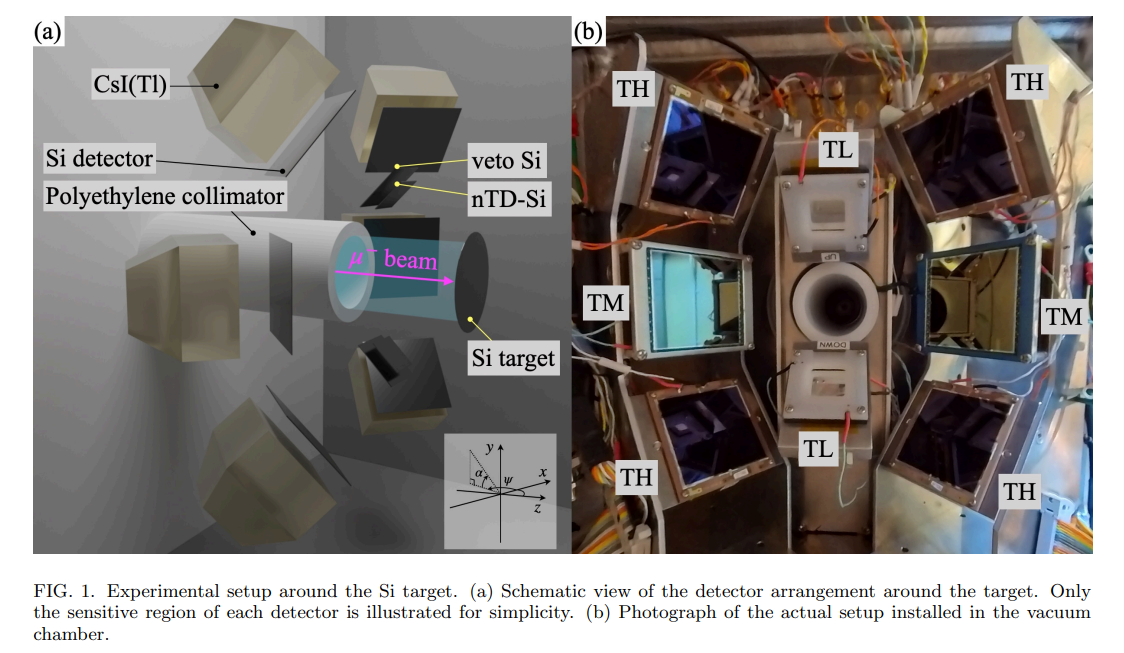
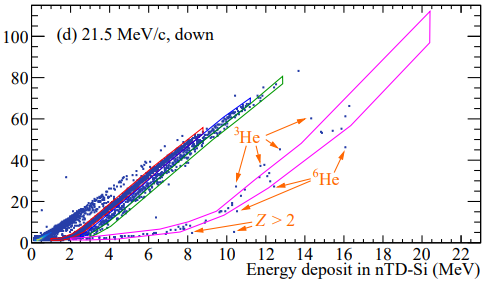
The experiment relied on dedicated charged-particle detection systems combining ∆E–E telescopes and neutron-transmutation-doped silicon detectors with digital pulse-shape analysis, enabling efficient particle identification over a broad energy range. An unfolding procedure was implemented to reconstruct the initial emission spectra from detector response and energy-loss effects. These measurements provide one of the most complete experimental datasets to date on charged-particle emission following muon capture on a light nucleus.
The reconstructed spectra are compared with contemporary transport and evaporation models. While proton and low-energy alpha components are reasonably reproduced, significant discrepancies are observed for composite particles, particularly at higher energies, underlining the sensitivity of the data to emission mechanisms and model assumptions.
This seminar will present the experimental setup and detector technologies developed for charged-particle spectroscopy in a muon beam, summarize the main spectral results, and discuss how such measurements can constrain nuclear de-excitation models and guide future detector and experimental developments.
Energy spectra of light charged particles emitted following muon nuclear capture on natSi
Zaher Salman