-
Francois Meot (Brookhaven National Laboratory)21/11/2019, 09:00
A zgoubi workshop - actually, more of a "zgoubi tutorial" - was organized in Boulder, CO, last August (https://zgoubi-workshop.com/), latest one in a long series which started in the early 2000s with the re-birth of FFAG science and happened to cover EMMA at Daresbury, FFAG schools, CBETA prototyping today, etc. The Boulder workshop gathered 20 attendees, who bent and sweat during four days...
Go to contribution page -
Andreas Adelmann (Paul Scherrer Institut)21/11/2019, 09:45
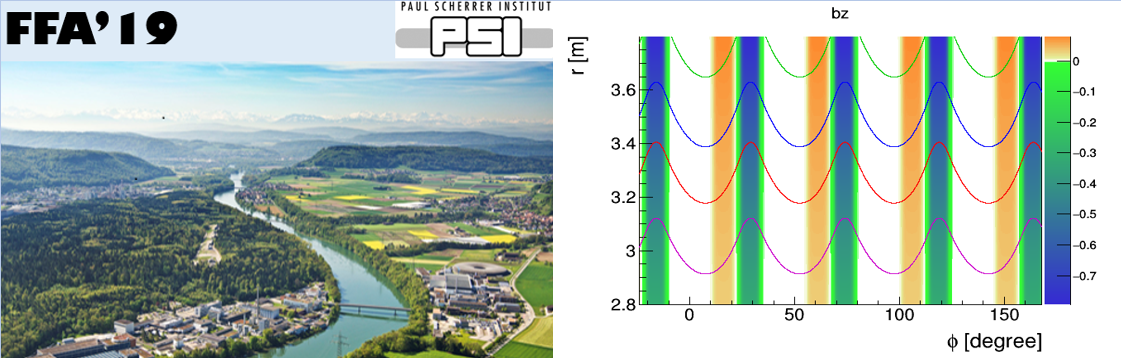
After a general introduction of OPAL, I will introduce a set of new features available with version 2.0 [1]. All new features will be presented together with examples of ongoing research projects. In the OPAL-cyc flavour, a robust way of generating matched distributions with linear space charge is introduced. A new method for describing fixed field accelerators (FFAs) in a very general way...
Go to contribution page -
Mr Matthias Frey21/11/2019, 11:00
In this talk the new adaptive mesh refinement capability of OPAL including the implementation of the hardware architecture independent Poisson solver is presented. This new feature enables to study neighbouring bunch effects in circular machines more precisely with the benefit of lower computational costs compared to standard Particle-In-Cell simulations of same resolution.The numerical model...
Go to contribution page -
Andreas Adelmann (Paul Scherrer Institut)21/11/2019, 11:45
Precise accelerator simulations are powerful tools in the design and optimization of exiting and new charged particle accelerators. We all know from experience, the computational burden of precise simulations often limits their use in practice. This becomes a real hurdle when requiring real time computation. I will demonstrate two techniques, based on Polynomial Chaos Expansion [1] and Deep...
Go to contribution page
Choose timezone
Your profile timezone: